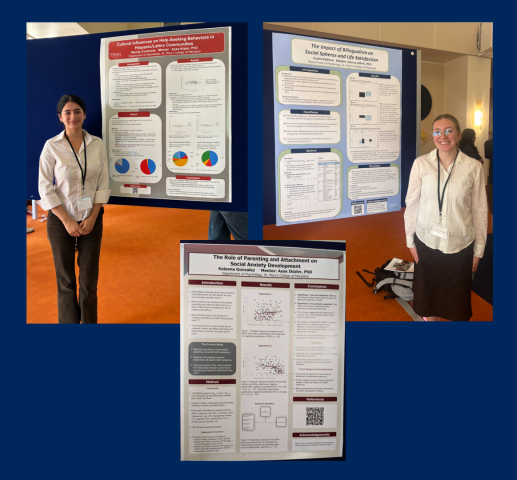
Wendy Contreras ’26 (psychology and neuroscience double major), psychology major Kaleena Gonzalez ’26, and Kaylee Holston ’26 (psychology and Spanish double major) traveled to the University of Virginia on Friday, April 17 to present research posters at the annual L. Starling Reid Undergraduate Psychology Conference.
Contreras presented her 2024 Seahawk Undergraduate Research Fellowship (SURF) project “Cultural Influences on Help-Seeking Behaviors in Hispanic/Latinx Communities” conducted under the mentorship of Associate Professor of Psychology Ayşe Ikizler ’07. In the United States, Hispanic communities underutilize professional mental health services despite experiencing significant mental health needs (Salcedo et al., 2017). Cultural beliefs, stigma, and structural barriers may contribute to lower help-seeking rates, yet few research has examined how these factors interact to shape attitudes toward mental health counseling in this population (Hussain & Zaini, 2025). The current study uses a mixed-methods approach to investigate how cultural values and psychological factors relate to willingness to seek professional help among adults of Hispanic background in the United States. A sample of 263 adults with South or Central American backgrounds completed an online survey in English or Spanish. The survey included validated psychological measures assessing psychological distress, stigma, religiosity, familism, and acculturative stress. Participants also responded to two open-ended questions exploring beliefs and attitudes about professional help-seeking for mental health concerns. Results showed a significant negative correlation between psychological distress and positive help-seeking attitudes, such that greater distress was associated with more negative attitudes. Familism and acculturative stress did not moderate this relationship. However religiosity and stigma were significant moderators. Among the participants with lower levels of religiosity and stigma, the association between distress and negative help-seeking attitudes was stronger, whereas no significant relationship was observed among those with higher levels. These findings suggest the complex role of cultural and psychological factors in shaping help-seeking attitudes. Identifying barriers such as stigma and culturally influenced perceptions of care may inform more culturally responsive outreach and interventions to improve mental health services in this underserved population.
Gonzalez presented her St. Mary’s Project (SMP) “The Role of Parenting and Attachment on Social Anxiety Disorder” being conducted under the mentorship of Ikizler. Research demonstrates a strong predictive relationship linking authoritarian parenting and insecure parent-child attachment as risks for social anxiety development (SAD) in children. However, less research has compared the relationships between mother and father parenting and attachment with SAD. Of the research that explores both mother and father parenting and attachment, conflicting evidence has been gathered on the separate roles mothers and fathers play on SAD in their children. The current study explored the relationships maternal and paternal authoritarian parenting and insecure mother- and father-child attachment share with SAD symptoms to explore how each parent factors into SAD outcomes and whether the gender of the child moderates the relationship. Participants were 114 undergraduate students who were raised by both mother and father figures. They completed an online survey assessing their social anxiety symptoms, parents’ use of authoritarian parenting style, and their attachment with each parent. A multiple linear regression analysis showed that only father insecure-attachment significantly predicted SAD. The gender of the child did not moderate the relationship for any of the variables. The findings from this research may inform childcare practices and development of parental resources offered to parents.
Holston presented her SMP “The Impact of Bilingualism on Social Spheres in Social Settings” being conducted under the mentorship of Assistant Professor of Psychology Jessica Leffers. Bilingualism acts as a vessel for acculturation and enculturation through formation of relationships. Relationships are homogeneous or heterogeneous, in that they create bonding and bridging capital that allows one to connect to their identity. Bonding and bridging capital lead to an increase in life satisfaction (LS). While research tends to focus on the cognitive abilities of bilinguals, it fails to look at the social impact of bilinguals attending a PWI on LS. In this study, we predicted that together second language (L2) age of acquisition (AoA), proficiency, and acquisition method would result in higher levels of heterogeneous relationships, which will have a positive impact on LS. College students from SMCM completed an online study which included the Social Network Strength Scale, the Satisfaction with Life Scale, and a language questionnaire. We found that L2 proficiency was related to having stronger L2 relationships, however AoA, proficiency, and acquisition method alone did not influence homogeneity. Additionally, the impact of L2 AoA, proficiency, and acquisition method on homogeneity in relationships determined LS. These findings suggest that language abilities can influence the strength and diversity of relationships and subsequent LS. Future research should focus on the social and mental implications of bilingualism.