
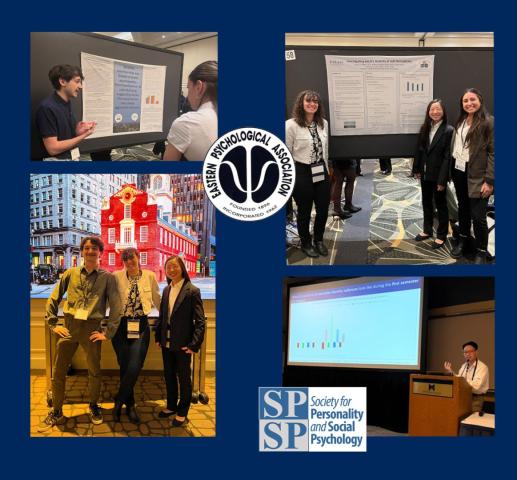
Representatives from the SMCM Department of Psychology made several contributions to recent regional, national and international conferences. Professor of Psychology Aileen Bailey, Associate Professor of Psychology Jennifer Tickle, Associate Professor of Psychology James Mantell, Assistant Professors of Psychology Anandi Ehman and Jessica Leffers and student collaborators had research presented at the 2026 Annual Conference of the Eastern Psychological Association in Boston in late-February while Assistant Professor of Psychology Kyle Lorenzo represented the SMCM Psychology department at the Society for Social and Personality Psychology (SPSP) 2026 Annual Convention in Chicago in late-February and the Society for Research on Adolescents (SRA) Biennial Meeting in Toronto mid-April.
Daniel Ake’ 27 presented a poster “Lower Dark Triad Traits in Sorority Members: A Social Identity Perspective” based on directed research conducted with Ehman. This exploratory study investigated associations between Greek life membership, cyberbullying experience, and Dark Triad personality traits among 748 college students. Sorority members showed significantly lower levels of cyberbullying victimhood and perpetration, along with psychopathy and Machiavellianism scores, than Fraternity members or non-Greek peers. These patterns suggest that the social norms and peer environments of different college organizations may correspond with differing levels of antisocial traits and cyberbullying behavior, though causality and directionality cannot be inferred from the cross-sectional design.
Leffers, Mary Govan ’27, and Emma Schneider ’26 presented a directed research-based poster “Investigating Adults’ Stability of Self Perceptions.” While self-concept appears early in childhood and remains fairly stable throughout the lifespan, distinct changes occur throughout adulthood. Younger adults focus on future events while older adults have a present orientation. The current study investigated the extent to which adults perceive changes between their current, past, and future selves. We examined whether psychological essentialist beliefs about self-stability predicted perceived changes. This study has implications for how adults view themselves and their overall life satisfaction. Taylor Basso ‘27, Pillar Dyson ‘27 and Amy Ludden ’27 were also named on the poster.
Leffers presented an additional poster “Investigating the Influence of Anthropic Thinking on Behavior in Various Animal Encounters” done with Zoe London (a collaborator from time at Leffers’ previous institution, Eckerd College). Humans tend to rely on anthropic thinking and social connotation when it comes to interacting with animals. This study aimed to determine how animal-human interactions correlate with anthropomorphism, anthropocentrism, and different animal groups. Results indicated that there was no significant correlation between measured behavior and anthropic thinking, but that more negatively viewed animal groups were treated more aggressively. Understanding different perceptions of animals could help better equip conservation initiatives aimed at protecting specific species.
Bailey and Tickle presented their research titled "Comparison of Traditional and Specifications Grading Policies on Student Attitudes and Outcomes." The goal of their research was to explore the impact of traditional, points-based grading compared to alternative, specifications grading on students’ engagement with the course material in several psychology courses. They evaluated grading system effects on confidence in understanding the course material, learning of the course material, motivation, anxiety, effort in the course, enjoyment of the course, and behavioral outcomes (final grade, test performance, and attendance). Grading type did not affect grades or academic performance. Despite some between course differences in attitudes, grading type did not seem to affect engagement, anxiety, or effort. However, students who experienced specifications grading indicated a higher likelihood of trying it again in the future. In sum, although specifications grading was generally liked, these data do not suggest large differences in attitudes or outcomes based on grading type.
Bailey also presented on research done in collaboration with Mantell. The talk entitled “Infusion of Data Science Instruction in an Undergraduate Psychology of Learning Course” discussed the value and pedagogical examples of an undergraduate psychology laboratory course with embedded data science instruction (scaffolded Python coding instruction within Jupyter Notebook). Specific examples of infused data science content and activities were highlighted and selected data from their pre-posttest research project (NSF IUSE #2235645) were presented.
In the symposium at SPSP “Dynamic Identity Across Multiple Timescales,” Lorenzo presented on research “The Many Selves of Everyday Life: Fostering Meaning in Life and Well-Being Among Emerging Adults” alongside Zhenchao Hu, Yerin Park, and Joseph Eisman. This work explored the process of experiencing multiple identities on a daily basis and how this was related to meaning in life and well-being. Among ethnically/racially diverse college students, higher levels of experiencing identities was associated with higher meaning in life and well-being at later times. These findings suggest that opportunities for exploring multiple social and role identities in a meaningful way are beneficial for long-term well-being among young people.
At SRA in Toronto, Lorenzo presented “Multiple Identity Saliences Across Self- vs. Other- Perception Among Ethnically/Racially Diverse College Students: Findings from the Twenty Statements Test.” Done in collaboration with Angela Zhao, Jiawei Wu & Tiffany Yip. This research found that among first-year college students, visible social identities like race and gender were most salient overall, but academic identities (“student”, “STEM major”, etc.) were more salient for self-perception than for others’ perception. These findings suggest that young people place greater emphasis on roles/career when defining themselves compared to when they perceive others to view them.