
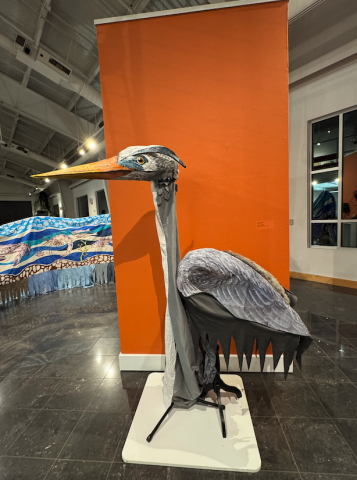
Invited Exhibition at Smithsonian Affiliate Gallery Features Collaborative Artwork by Environmental Studies Faculty and Students
An invited exhibition co-produced by Parisa Rinaldi and Barry Muchnick, Environmental Studies faculty at St. Mary’s College of Maryland, brought together students, artists, and community members in a powerful exploration of climate resilience through creative collaboration. Climate Affect Collective: Puppets with a Purpose was on view March 6–29, 2026 at Annmarie Sculpture Garden & Arts Center, a Smithsonian Affiliate, and featured multi-media artworks generated through coursework, workshops, and community partnerships.
The Climate Affect Collective – an initiative launched by the Department of Environmental Studies – invites participants to join a growing network of events and collaborators dedicated to elevating arts engagement around climate resilience. The Climate Affect Collective fosters ecological and imaginative renewal through awe, wonder, and creative collaboration.
The works on view reflected a multi-semester process of engaged arts-based research and production. During the Fall 2024 semester, students in environmental studies courses examined the complex relationships between people and plants by studying flowers grown at the Kate Chandler Campus Community Farm. Through research into each plant’s biology, uses, and cultural narratives, students developed projects enriched by hands-on workshops with visiting artists Saya Benham and Fay Nourani.
In Spring 2025, the initiative expanded through collaboration with visiting artists Jan Burger and Emma Skurnick of North Carolina’s Paperhand Puppet Project. Together with students and community members, they explored how puppetry can challenge assumptions about nature, deepen interspecies connections, and raise awareness across human and ecological systems. The year culminated in a large-scale puppet parade and Earth Day performance, Making the Invisible Visible, directed by Performing Arts faculty collaborator Diego Villada and featuring live music by student, faculty, and community musicians. The event highlighted themes of beauty, belonging, biodiversity, and the evolving role of humans in the Chesapeake Bay region.
“This exhibition demonstrates how creative practice and environmental inquiry intersect in meaningful ways,” said Department of Environmental Studies Chair Barry Muchnick “By working collaboratively across disciplines and with our community, students learn about climate resilience and actively shape new ways to imagine and respond to it.”
The exhibition was celebrated with a community “Bad Art” Night on March 20 that offered an evening of playful, participatory creativity. Guests were invited to repurpose recycled materials into their own puppet creations—whether thought-provoking, hilarious, or wildly unhinged. Prizes were awarded for standout works, while entertainment, a cash bar, and a food truck rounded out the festive atmosphere.
By bringing together research, artistic practice, and community engagement, the exhibition exemplified how creative expression can inspire action and imagination in response to ecological challenges.