On Saturday, Dec. 6, at the Chesapeake Regional Ethics Bowl (hosted by the University of Maryland, Baltimore County), the Seahawks Ethics Bowl Team finished in a tie for second place, and won one of the three bids to the National Ethics Bowl, to be held March 7-8 in St. Louis. SMCM won all four of its rounds, including wins against teams from Villanova and Penn State. The team progressed to the semi-final round, where they tied with Washington & Lee University. This is the fifth time in thirteen years that St. Mary’s has qualified for the Nationals.
St. Mary’s College bested 13 other teams in the field, including Tufts, Temple, Princeton and Virginia Tech.
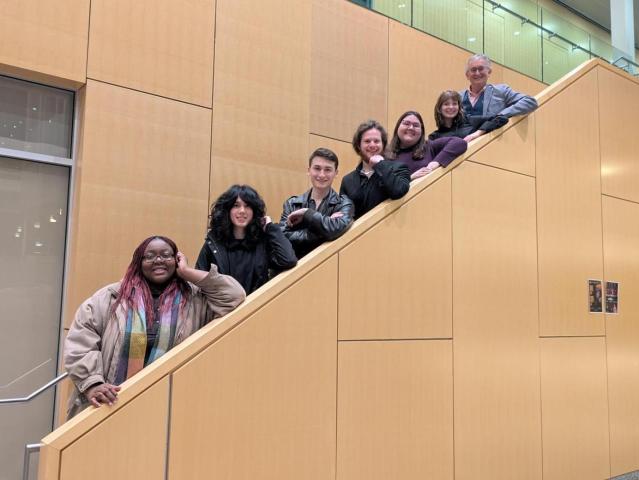
The team performed with excellence and grace, and is pictured above: Bechorah Aguoru, Philip Eisenstein, Argyrios Tasikas, Mason Lipczenko, Lainey Shankle, Ella Skidmore and Coach Michael Taber, Ph.D., associate professor of philosophy.
The team members spent the semester researching and preparing positions on the 15 cases posted by the sponsors of the Intercollegiate Ethics Bowl. Teams know the cases, of course, and therefore the general issues, but don’t find out until each round what the question is that they are being asked to address.
The team presented on the following cases at the competition:
- Should a criminal record disqualify a candidate from holding office? (Using France’s Marine Le Pen as an example.)
- Should justice systems treat femicide as a distinct category of crime to highlight gender-based crime, or does this risk creating unequal justice?
- Do new burial practices that turn human remains to soil express proper moral respect for person or risk reducing human life to mere material?
- Under what conditions, if ever, is it ethical to use shock tactics such as animal cruelty to call attention to a practice like animal farming?
In the semi-final round, the team was posed their final question: “How should we deal with overtourism in a way that is fair to locals, tourists, and the concerns of political sovereignty?”
Ethics Bowl isn’t really a debate between teams, because teams can agree with each other on their positions on a given issue. (They can point out how the other team’s reasoning or examples could have been improved.) No one needs to say anything that they don’t believe in.
The team would like to thank Mandy Taylor, director of the Writing and Speaking Center, and to the tutors, who provided valuable advice in a practice session. The team also expresses appreciation to Lucy Myers, fiscal associate, who took care of the ever-necessary logistics.