
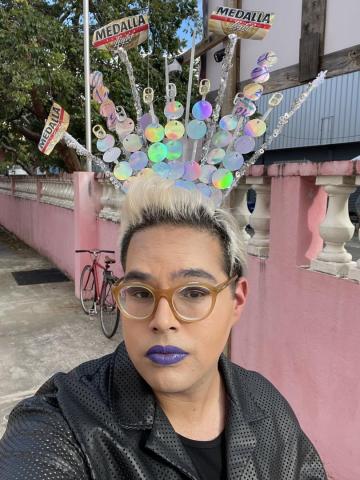
Presents: Dozandri Mendoza (they/she, elle/ella)
Throwing Shade and the Political Wit of the Femme Queen
Thursday, March 26 | 4:45 – 6:00 pm, Cole Cinema, Campus Center
Talk Description: Being “shady” and “reading (someone)” have entered popular discourse from their origins within the Black/Latinx queer performance culture of the Ballroom scene, in part due to the widespread impact of the documentary film Paris Is Burning (Livingston 1990). In this talk, I combine deleted scenes from Paris and the House of Xtravaganza with ethnographic observations from a co-curated “Kiki Ball del Palabreo” in San Juan, Puerto Rico, to construct an archive of the verbal artform. I explore shade’s various embodied and multimodal forms as a Black femme queen semiotic choreography attuned to resisting colonialism, imperialism, desplazamiento, and linguistic oppression. I also explore how, while reading and throwing shade can be transformative, they can also be used to reify inequitable power dynamics, highlighting tensions between North American Ballroom and Bólrüm Caribeño/Ballroom from the Global South.
Dozandri Mendoza (they/she, elle/ella) is a sociocultural linguist at the intersection of dance studies/dance anthropology, Puerto Rican Studies, Black Studies, and semiotics. They are passionate about curating creative research-based interventions with students through their pedagogy and research projects. Their research agenda is grounded in community-based participatory arts research in collaboration with the kiki/Ballroom scene in San Juan, Puerto Rico. Their work explores the semiotics of memory/ancestry, colonial tensions of language, verbal art traditions such as throwing shade/reading, and the proprioceptive semiotics of feeling "cunt" in Ballroom performance. They also think about how dance and performance can be profound sites through which to examine the effects of and resistance to colonialism, empire, and race/class/gender-based oppression inspired by their time collaborating/walking in kiki/Ballroom spaces.
THIS YEAR’S THEME – Speaking Back: Language as Rebellion.
The WGSX Colloquium (March 25–26, 2026) centers on “Speaking Back: Language as Rebellion,” examining the power of language—understood broadly as speech, narrative, embodiment, symbolism, aesthetics, and cultural practice—as a catalyst for social change. The colloquium explores how language in its many forms shapes and reinforces gendered identities, cultural norms, and social hierarchies, while also highlighting how women and gender-diverse individuals strategically “speak back” to systems that marginalize or silence them.
Through critical dialogue and the sharing of scholarly, activist, and artistic perspectives, the event interrogates language’s dual role as both a tool of oppression and a powerful site of resistance, celebrating the creative ways communities reimagine meaning-making in their ongoing struggles for equity, justice, and freedom.