
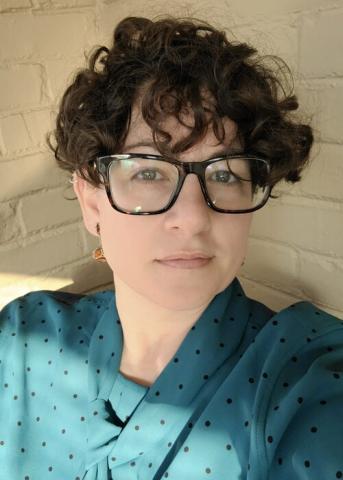
Presents: Jenny L. Davis
More than just "a word" for us: Exploring the possibilities of Indigiqueer Language Futurisms
Wednesday, March 25 | 4:45 – 6:00 pm, Cole Cinema, Campus Center
Queer linguistics and Indigenous language documentation and revitalization are usually imagined (and taught) as totally separate fields. In the field of Indigenous language documentation and revitalization, discussions of Indigenous gender and sexuality are largely absent. Native Americans are similarly missing from the field of language, gender, and sexuality. In other words, the expectation created within linguistics is that speakers of Native American languages are never queer, and those represented in queer linguistics are never Native. This talk traces my training and work in these seemingly disparate (sub)fields and the intellectual histories that lead to them being imagined and practiced separately in contrast with the actual the inextricable connections between language and Indigenous gender, sexuality, and relationality. Then, through discussing a current project of a “Queer Muskogean Lexicon” that bridges creative writing, Indigenous Studies, and queer and feminist lexicography, I map out the possibilities of where Indigiqueer linguistics and Indigenous language futurisms meet.
Jenny L. Davis is a citizen of the Chickasaw Nation and an Associate Professor of Anthropology and American Indian Studies at the University of Illinois, Urbana-Champaign where she is the director of the American Indian Studies Program. She is the author of Talking Indian: Identity and Language Revitalization in the Chickasaw Renaissance (2018), two poetry collections: Trickster Academy, (2022) and Extant, (2026), and a co-edited volume Queer Excursions: Retheorizing Binaries in Language, Gender, and Sexuality (Oxford University Press, 2014).
THIS YEAR’S THEME – Speaking Back: Language as Rebellion.
The WGSX Colloquium (March 25–26, 2026) centers on “Speaking Back: Language as Rebellion,” examining the power of language—understood broadly as speech, narrative, embodiment, symbolism, aesthetics, and cultural practice—as a catalyst for social change. The colloquium explores how language in its many forms shapes and reinforces gendered identities, cultural norms, and social hierarchies, while also highlighting how women and gender-diverse individuals strategically “speak back” to systems that marginalize or silence them.
Through critical dialogue and the sharing of scholarly, activist, and artistic perspectives, the event interrogates language’s dual role as both a tool of oppression and a powerful site of resistance, celebrating the creative ways communities reimagine meaning-making in their ongoing struggles for equity, justice, and freedom.