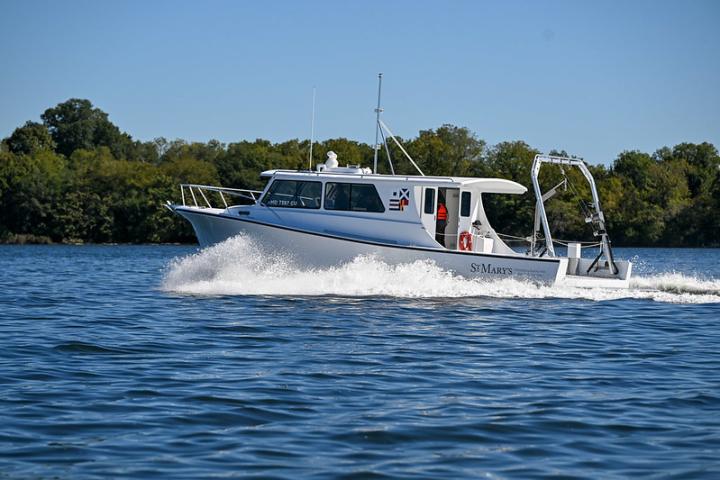
St. Mary’s College of Maryland welcomed a significant new addition to its marine science program Wednesday, Oct. 7, with the arrival of R/V CY46, a 46-foot, purpose-built research vessel that expands hands-on teaching and research opportunities for students and faculty.
R/V CY46 and associated equipment was purpose built to allow students to study the biological, chemical and physical properties of the St. Mary’s River, Lower Potomac River and Chesapeake Bay.
Launched in the fall of 2021, the College’s marine science program is the only undergraduate program of its kind in Maryland. From its initial proposal, a boat outfitted to meet teaching and research needs was a must-have component to the curriculum, said Cassie Gurbisz, associate professor of marine science.
U.S. Rep. Steny Hoyer (D, 5th), in whose district the College lies, secured a $900,000 appropriation in support of the College’s marine science program in the fiscal year 2022 omnibus bill. The College utilized the entirety of the federal award in two specific areas: 1) the acquisition of a purpose-built research vessel capable of carrying students and instructors for educational and research activities throughout the Chesapeake and associated river systems; and 2) the acquisition of scientific equipment and instrumentation.
North Division Dean Sahar Shafqat oversaw the overall project, identifying key stakeholders and educating herself on the various steps included in the process.
“I worked to understand the obstacles, which involved working through some complicated legal, regulatory and financial issues, she said. “There was understandably some hesitation in moving forward with a project of this scale, but I understood from the faculty just what a remarkable asset this research vessel would be for the program, the College, and our students, and that made it easy for me to champion the project.”
Faculty and staff worked with naval architect Iver Franzen and Composite Yacht in Royal Oak, Maryland, for the build. Bryan Lloyd, the College’s director of boat operations, monitored the progress of the build on a weekly basis with onsite inspections at Composite Yacht.
Gurbisz said working with Franzen and staff from Composite Yacht was very positive and everyone was receptive to the College’s teaching and research requirements for the vessel. “We all worked together to turn a vision for what we wanted to accomplish into an actual design for a boat and then Composite Yacht built it,” she said.
The final product arrived in St. Mary’s City just before noon on Oct. 7, with the crew having accomplished a data collection request from the Department of Natural Resources along the way.
“It’s a very exciting day,” Shafqat said after the boat’s arrival. “I’m really proud that the College took a very bold step to support the curriculum and the students. It’s going to go so far in providing a unique experience for our students in marine science, environmental studies, biology, and potentially anthropology and archaeology,” she said.
Gurbisz said long term, she sees the vessel being used primarily for faculty and students but also for the greater scientific community.
This R/V CY46 joins a fleet of two smaller boats and is a critical piece of the young marine science program as it will allow students and faculty to work on the water more often than they can with the smaller vessels that hold less than half the amount of people that the new vessel can accommodate. Much of the research, Gurbisz said, has been done off the dock, which is not the ideal experience for marine science undergraduates.
“We really want to make sure that from their first year all the way to when they graduate, they're getting on the boat as many times as they can,” said Gurbisz.