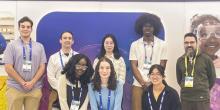
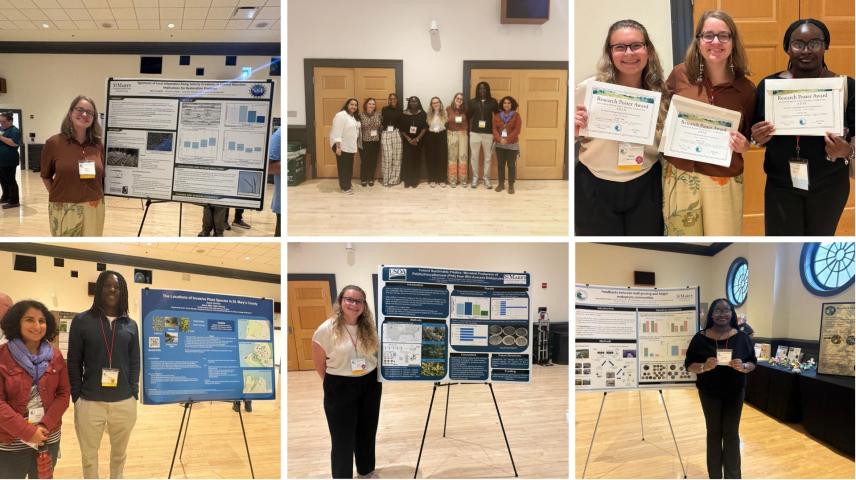
Students Riley Strohecker ’27, Krystal Moore-Nicks ’26, and Mara Coughlin ’27 won first, second, and third place, respectively, for Best Undergraduate Research Poster Presentation at the Maryland Native Plant Society Annual Conference at the University of Maryland, College Park held on September 12.
Riley Strohecker presented research she conducted this summer as part of the Summer Undergraduate Research Fellowship (SURF) program under the supervision of Assistant Professor of Biology Lorena Torres Martínez. Riley studied the diversity of endophytes associated with wild avocado relatives and evaluated the ability of endophytic bacteria to produce PHA, a biopolymer that can serve as a substitute for petroleum-based plastics. Her research will be part of her SMP and it is partially funded by a cooperative agreement between Torres Martinez and the USDA.
Krystal Moore-Nicks presented her SMP project, which was conducted under the supervision of Assistant Professors of Biology Elizabeth Hamman and Lorena Torres Martínez. Krystal studied the interactions between snail grazing and fungal endophyte communities in smooth cordgrass (Spartina alterniflora), a key foundation species in salt marshes. Her findings will provide insight into how snail grazing may contribute to salt marsh dieback by altering fungal communities within plant tissues. Her poster was also coauthored by undergraduates Reina Whittington '28 and Rebecca Spinicchia '28 who performed the fungal characterization component of the project and helped with the experimental set up and data collection as part of their directed research experience. Krystal's project was funded by the Maryland Native Plant Society and the Biology Flores Award.
Mara Coughlin presented research she conducted this past summer as a Research Undergraduate Assistant in the laboratory of Torres Martínez. Mara assessed patterns of local adaptation in smooth cordgrass (Spartina alterniflora) along a salinity gradient on the Gulf Coast. Her findings will help restoration managers identify specific genotypes that can tolerate high levels of salinity. Her summer research experience was funded through an ongoing collaborative NSF-funded project involving SMCM, the University of South Alabama, and Texas A&M University–Corpus Christi.
The conference was also attended by Great Mills High School student Damir Hinmon, who presented his work on invasive species mapping. Damir worked with Assistant Professor of Environmental Studies Parisa Rinaldi on a summer STEM internship, during which he developed community GIS skills and developed a project in collaboration with the Youth Resilience Leaders program. Damir was the only high school poster presenter and was highly praised by conference attendees.